

To understand what MCP is, you first need to understand what APIs are. Some of you may already know, but just to recap what APIs are, here are a few lines.
API
API stands for Application Programming Interface (and for a non-technical person, that probably doesn’t explain much).
So let me explain it in simple terms.
When you go to a restaurant (the server), you ask for a dish like a curry (the dish is the data). To get that dish, you perform certain actions — these actions are the APIs.
For example:
- You ask what types of curries are available (an API to list all dishes)
- You ask how to place an order (an API for placing orders — maybe through a waiter)
- You ask how to make a payment (another API for payment)
Note: Each restaurant may have a different process for how an order works.
After performing these steps (filling in the required parameters for each API), you finally get what you need.
Simple, right?
In this example:
- The restaurant is the server
- The dish is the data you need from the server
- All actions are the APIs exposed by the restaurant (server) to interact with it
MCP
Now that we know what an API is, what the f**k is MCP?
Be patient — let’s continue with the same restaurant example.
From my super-optimised world of robots, the problem with this human ordering process is that it varies too much from restaurant to restaurant. In some places, one waiter handles everything; in others, you have to go to different counters for different things.
So in my dictatorship, I force every restaurant in the world to follow the same process: a common help desk. And the way this help desk works is identical everywhere.
This help desk will list all the actions you can perform in the restaurant (called tools in MCP terms), like:
- Get all dishes
- Choose a dish
- Make a payment
All at the same desk.
Now, whenever you want to do anything, you simply go to this desk. You don’t need to search around the restaurant anymore.
So in every restaurant you visit, you can just say:
“Order a curry, less spicy, online payment.”
And every restaurant will know exactly what to do with that information — without asking extra questions — because the whole world follows the same standard.
This is exactly what MCP does.
APIs today are different for every server, even for the same type of action. You also have to manually figure out how each API works.
With MCP, when a server exposes its MCP, it must declare:
- What actions (tools) it supports
- What parameters each action requires
For example:
- To order a dish, you provide the dish name
- To make a payment, you provide the amount
And every server provides a common way to perform these actions.
That is MCP.
By the way, MCP stands for Model Context Protocol.
When MCP lists actions (tools), it also returns what each action means. For example:
order_dish   : Order a dish from my restaurant
make_payment : After ordering, make payment for the dish ordered
If this list is given to an AI, the AI understands what each action does. The model now has context about what it can do and how to do it.
That’s why it’s called Model Context Protocol.
What is the Model Context Protocol (MCP)?
MCP (Model Context Protocol) is an open-source standard for connecting AI applications to external systems.
Using MCP, AI applications like Claude or ChatGPT can connect to data sources (e.g., local files, databases), tools (e.g., search engines, calculators), and workflows (e.g., specialised prompts) — enabling them to access information and perform actions.
Think of MCP like a USB-C port for AI applications.
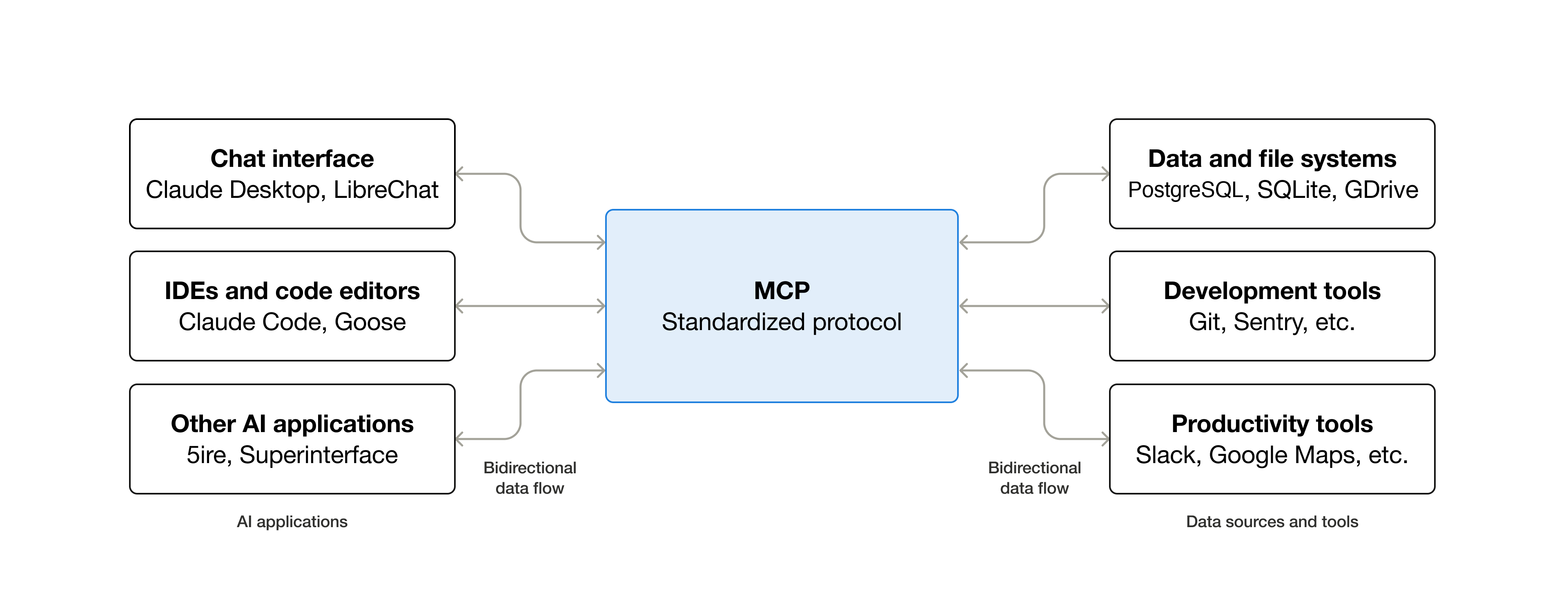
Source is https://modelcontextprotocol.io/docs/getting-started/intro for above terms
At JoyzAI, we have created a system where you can integrate any MCP with any AI model — like Shopify, Razorpay, Google Sheets, and many more to come — so the AI can perform all the actions that you would normally do manually on these platforms.
You can also integrate any custom MCP. Cool, right?
MCP removes the time wasted reading API docs, schemas, and endpoints — the AI directly knows what to call and how.
If you have any doubts, contact me at piyushpuniya2001@gmail.com